

The Paul Chiang I Know: From Police Officer to Member of Parliament,a Pragmatic Advocate for Community Safety
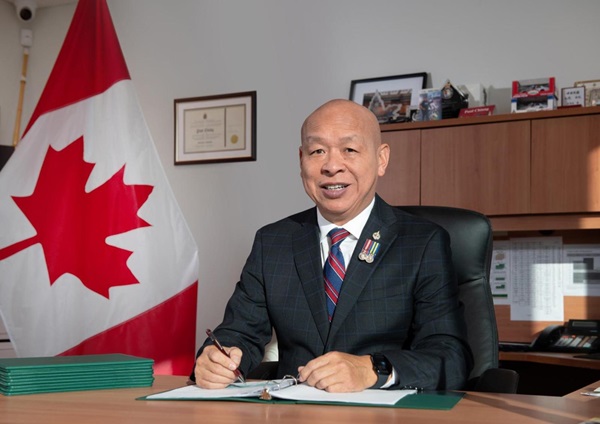
【By Betty Gu|Red MapleJournal】 In this year’s Markham municipal election, 11 candidates are competing for four regional councillor seats.
With so many candidates on the ballot, voters can look beyond campaign platforms and promises and consider something else: the life a candidate has lived, and how those experiences might shape the way they serve a city.
I have known Paul Chiang for many years.
His life has taken him through immigration, entrepreneurship, policing, community service and federal politics. Looking at that journey as a whole may offer a better understanding of why he has chosen to run for regional councillor than simply looking at a political résumé.
Arriving in Canada at 16: From Starting Over to Putting Down Roots in Markham
Paul Chiang was born in Karachi in 1960.
His grandparents left China for what was then British India in 1927, and the family later lived in what is now Pakistan. In 1976, at the age of 16, Chiang came to Canada with his parents.
From China to India, from India to what is now Pakistan, and eventually to Canada, his family crossed borders and rebuilt their lives more than once.
Canada was where Chiang began the next chapter of his life.
He worked as an airport shuttle driver, ran a pizza business and a Chinese restaurant, and managed a fitness club.
Those experiences were the foundation of his Canadian life. From earning a living to running businesses, he learned about Canadian society through everyday life, while gradually building a career and a connection with the community around him.
But it was his 28-year career in policing that would have the deepest influence on the way he approached public service.
28 Years in Policing: More Than a Résumé
In 1992, at the age of 32, Chiang entered policing.
Over the next 28 years, he served with the London Police Service, Durham Regional Police Service and York Regional Police Service, eventually retiring as a sergeant. Publicly available information from Canadian public safety organizations has also documented his work as a sergeant in multicultural and cultural resources, where he helped build relationships with diverse communities.
Simply listing the police services where he worked, however, does not fully capture what those 28 years meant.
His career took him through a wide range of frontline responsibilities, including patrol,crime-scene investigations, sexual-assault response, homicide investigations, community response, public-order policing and police recruitment. He was also a member of a motorcycle ceremonial unit and took part in major ceremonial assignments, including escort duties for world leaders during the G20 summit.
One of the longest and most significant assignments of his police career was with a multicultural and hate-crime investigative unit.
In other words, his experience was not confined to a single area of policing. Over nearly three decades, he worked across the spectrum—from routine patrols and major investigations to emergency response, public order and community relations in a multicultural environment.
Policing is different from many other professions.
When danger appears, most people instinctively move away from it. Police officers are expected to do the opposite—to move toward the danger, and to step forward when someone needs help.
That requires more than physical strength or courage.
It requires listening, to understand what people are going through; observation, to identify risks and warning signs; investigation, to establish the facts; fairness, to make sound judgments in complicated situations; and composure, to remain calm during conflict and emergencies.
It also requires constant awareness and strong teamwork.
After 28 years on the front lines, Chiang’s experience was shaped not by abstract numbers or policy papers, but by individual people, specific cases and problems that often had to be addressed immediately.
What ultimately remained from those years may have been less about the titles on a résuméand more about a practical way of working:
Understand the problem first. Then look for a solution. Listen to the people affected before deciding what needs to be done.
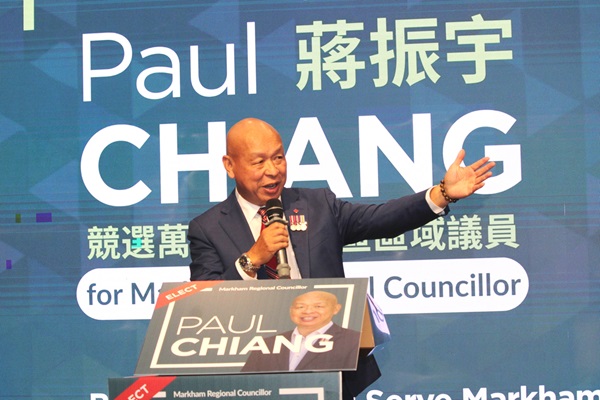
A Politician More Focused on Action Than Rhetoric
Paul Chiang is not the kind of politician who relies heavily on grand speeches or sweeping promises.
He is not particularly inclined toward making lofty commitments, nor does he seem to depend on slogans to define himself.
His instinct is to take a concrete problem and ask: What exactly is happening? Who is affected? Who needs to be involved? And what can actually be done?
In 2021, Chiang was elected Member of Parliament for Markham—Unionville.
During his time in Parliament, he served as parliamentary secretary to ministers responsible for housing, multiculturalism and inclusion, and was involved with committees dealing with public safety and national security. Public records also show that he later served as parliamentary secretary to the Minister of Immigration, Refugees and Citizenship.
But in Markham, his approach to public safety did not stop at policy discussions in Ottawa.
While serving as an MP, he organized a series of public crime-prevention forums addressing issues that mattered directly to local residents, including home invasions, break-ins, personal safety, road safety, home security and vehicle theft prevention.
His approach was rooted in a simple belief: effective solutions often begin with direct contact with the community—listening to residents, then working with different levels of government, law-enforcement agencies and community organizations to address the problem.
That approach closely resembles the way he worked as a police officer.
When responding to a call, a confrontation or an investigation, an officer first needs to understand what happened, assess the situation and then take action.
Public service is not so different.
From Community Safety to National Action
In Ottawa, Chiang was involved in the National Action Plan to Combat Auto Theft.
The national initiative was designed to disrupt and dismantle organized crime networks involved in vehicle theft and bring those responsible to justice.
According to publicly released figures, vehicle thefts across Canada fell by 19 per cent in 2024 compared with the previous year, followed by further declines over the next two years.
Those efforts have produced measurable progress at the national level.
But progress in public safety does not mean the work is finished.
Vehicle theft, break-ins, personal safety and organized crime all have a direct impact on the everyday lives of ordinary residents.
That is why prevention and enforcement require sustained attention, and why cooperation among governments, law-enforcement agencies and communities remains important.
It is also consistent with a basic lesson shaped by 28 years in policing: public safety is not simply about responding after something goes wrong. It is also about identifying problems early, reducing risks and preventing incidents before they happen.
In a Multicultural Community, Language Is Only the Beginning
Markham is one of Canada’s most diverse communities.
People from different ethnic, linguistic and cultural backgrounds live side by side, and they do not all have the same priorities.
Some residents are concerned about transportation and housing. Others focus on public safety and economic development. Still others care most about community facilities, seniors and family services.
Chiang speaks English, Mandarin and Cantonese, and also has knowledge of several other languages, including Hubei dialect, Hakka, Urdu, Hindi and Punjabi. His language abilities have also been noted in publicly available information from Canadian public safety organizations.
The ability to communicate in so many languages is unusual, particularly in public service in a diverse Canadian community.
Of course, speaking multiple languages does not by itself make someone an effective public servant.
But for a police officer who spent years working in multicultural communities, language can make a practical difference. It can remove a barrier to communication and make it easier to hear directly from people whose experiences may otherwise be difficult to understand.
More importantly, Chiang spent significant time working in multicultural and hate-crime-related policing.
For him, multiculturalism was therefore not simply a political theme that appeared during an election campaign. It was part of his professional life for many years.
That experience has also shaped the way he approaches community affairs in Markham.
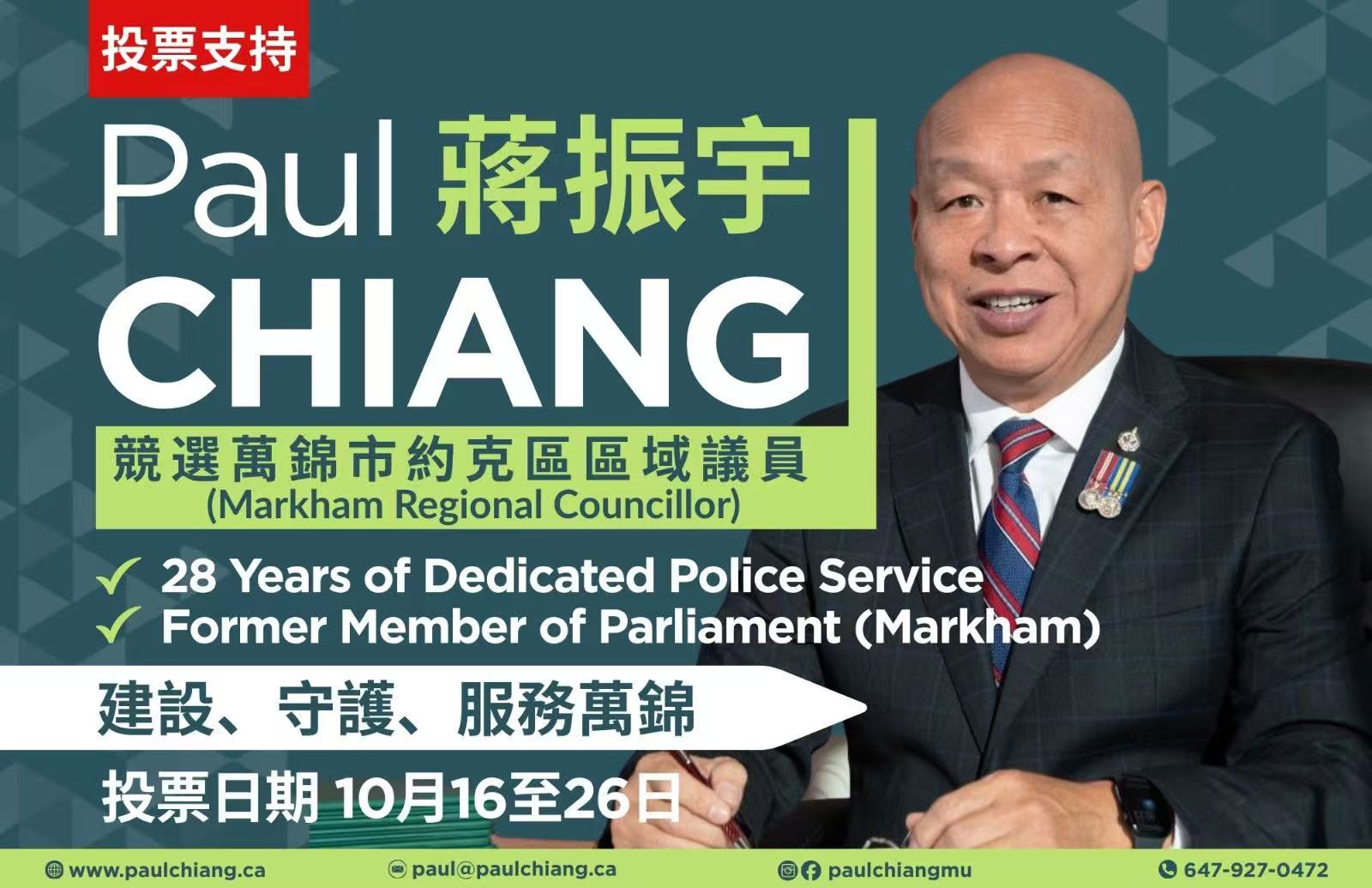
Business Experience and the Reality of Difficult Choices
Before becoming a police officer, Chiang ran a pizza business and a Chinese restaurant and managed a fitness club.
Running a business teaches a very practical lesson: resources are never unlimited.
Costs, employees, customers and day-to-day pressures all require decisions based on real-world constraints.
Municipal government faces a similar reality.
Roads, transportation, public safety, community facilities and urban development all compete for attention, while public resources and municipal budgets are limited.
Local government, therefore, is not simply about identifying what people would like to have. It is also about recognizing constraints, balancing competing needs, setting priorities and finding solutions that can actually be implemented.
That is another perspective that can come from experience in business.
50 Years in Canada, Growing Alongside Markham
In 1976, at the age of 16, Paul Chiang arrived in Canada.
In 2026, half a century has passed.
Those 50 years have also been a period of profound change and growth for Canada and for Markham.
From an immigrant teenager to a business owner, police officer, community advocate and Member of Parliament, Chiang’s life has unfolded alongside the evolution of the community he now calls home.
He has watched Markham grow from a collection of communities into the diverse and vibrant city it is today. Along the way, he has built his own life, career and record of community service here.
Fifty years is a long time, but it is also made up of countless ordinary days.
The roads we travel, the people we meet and the experiences we accumulate eventually become part of the story we carry with us—and, in Chiang’s case, part of the story of a city that has grown alongside him.
Today, he is once again standing before the people of Markham.
This time, not simply as a candidate, but as someone who has spent 50 years building a life in Canada and many of those years living and working in the community he now hopes to continue serving.
After five decades, he is taking on a different role.
But the underlying motivation remains the same: to serve the community.